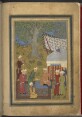
Niẓāmī Ganjavī: Khamsah The five poems making up the Khamsah by Niẓāmī Ganjavī (1140 or 41-1202 or 3), containing one double and 20 single miniatures in the Herat later Timurid style. The attributions to various artists beneath the lower margins of the miniatures were added later but the miniatures on ff. 37v, 135v, 190r, 214r, 225v,and 273r are considered to be possibly the work of Bihzād. One of the paintings (f 284r) is clearly dated 900 AH (1494/95). The history of the manuscript is documented with more than 70 inscriptions and seal impressions dating from 1564/65 to 1782. Illustrations: (1v-2r) The manuscript possibly being presented to Sulṭān Mīrzā Barlās, ruler of Samarkand. Ascribed to Mīrak Khurasānī. The patron holds a piece of paper which appears to have the name ʻAlī Fārsī on it – in addition to further inscriptions which have not yet been deciphered. Makhzan al-asrār. Illustrations: (5v) The Prophet mounted on Burāq and escorted by angels passing over the Kaʻbah. (16r) Sulṭān Sanjar and the old woman. Ascribed to Mīrak(27v) Hārūn al-Rashīd and the barber. Ascribed to Mīrak and Bihzād. Khusraw u Shīrīn. Illustrations: (37v) The elders pleading before Hurmuzd on behalf of the young Khusraw. Ascribed to Bihzād.(39v) Shīrīn being shown the portrait of Khusraw by one of her handmaidens. Ascribed to Mīrak.(62v) Farhād arriving at Shīrīn’s palace. Inscription: ‘Written for the library of the great Amīr, the most just, the most courageous Amīr ʻAlī Fārsī Barlās, may God strengthen his fortune until the day of resurrection). Ascribed to Mīrak and ʻAbd al-Razāq,(72v) The suicide of Farhād on Mt. Bisitun. Ascribed to Mīrak and Bihzād.(93r) Shīrūy murders Khusraw while he sleeps in bed. Architectural inscriptions containing Persian quatrain. Ascribed to Bihzād. Laylā u Majnūn. Illustrations:(106v) Laylā and Majnūn at school. Ascribed to Mīrak and Bihzād, but to Qāsim ʻAlī in the text panel. Inscription over doorway containing Qur’anic texts.(128v) Majnūn visited by Salīm in the desert. Ascribed to Bihzād.(135v) Mourning the death of Laylā’s husband, Ibn Salām. Ascribed to Bihzād.(137v) Laylā and Majnūn fainting. Ascribed to Bihzād.(144v) The death of Majnūn on Laylā’s grave. Ascribed to Bihzād. Haft paykar. Illustrations:(154v) The building of the palace of Khavarnaq for Nuʻmān who was the guarian of the young Bahrām Gūr. Ascribed to Bihzād.(157r) Bahram Gūr kills the dragon. Ascribed to Bihzād. An artist’s name has been erased from the text panel(175r) Bishr feeling for the body of his drowned companion Malīkhā with a branch (story told by the Tartar princess). Ascribed to Bihzād underneath, but to Qāsim ʻAlī in the text panel.(190r) The owner of the garden discovering maidens bathing in his pool (story told by the Greek princess). Ascribed to Bihzād. Iskandarnāmah. Beginning in this copy with the Khiradnāmah (ff 199v-234v). Illustrations:(214r) Iskandar, in the likeness of Ḥusayn Bāyqarā, with the seven sages. Inscription: Year AH 900 (1494/95).(225v) Iskandar on the island near the ‘Lion’s Mouth’ whirlpool beating the wolfskin drum of the bronze talisman in order to still the waters. One of the figures in the boat is shown to be the likeness of Ḥusayn Bāyqarā.followed by the Sharafnāmah (ff 235v-303r)-(273r) Iskandar, in the likeness of Ḥusayn Bāyqarā, visiting the wise man in a cave. Ascribed to Bihzād underneath, but to Qāsim ʻAlī in the text panel.